
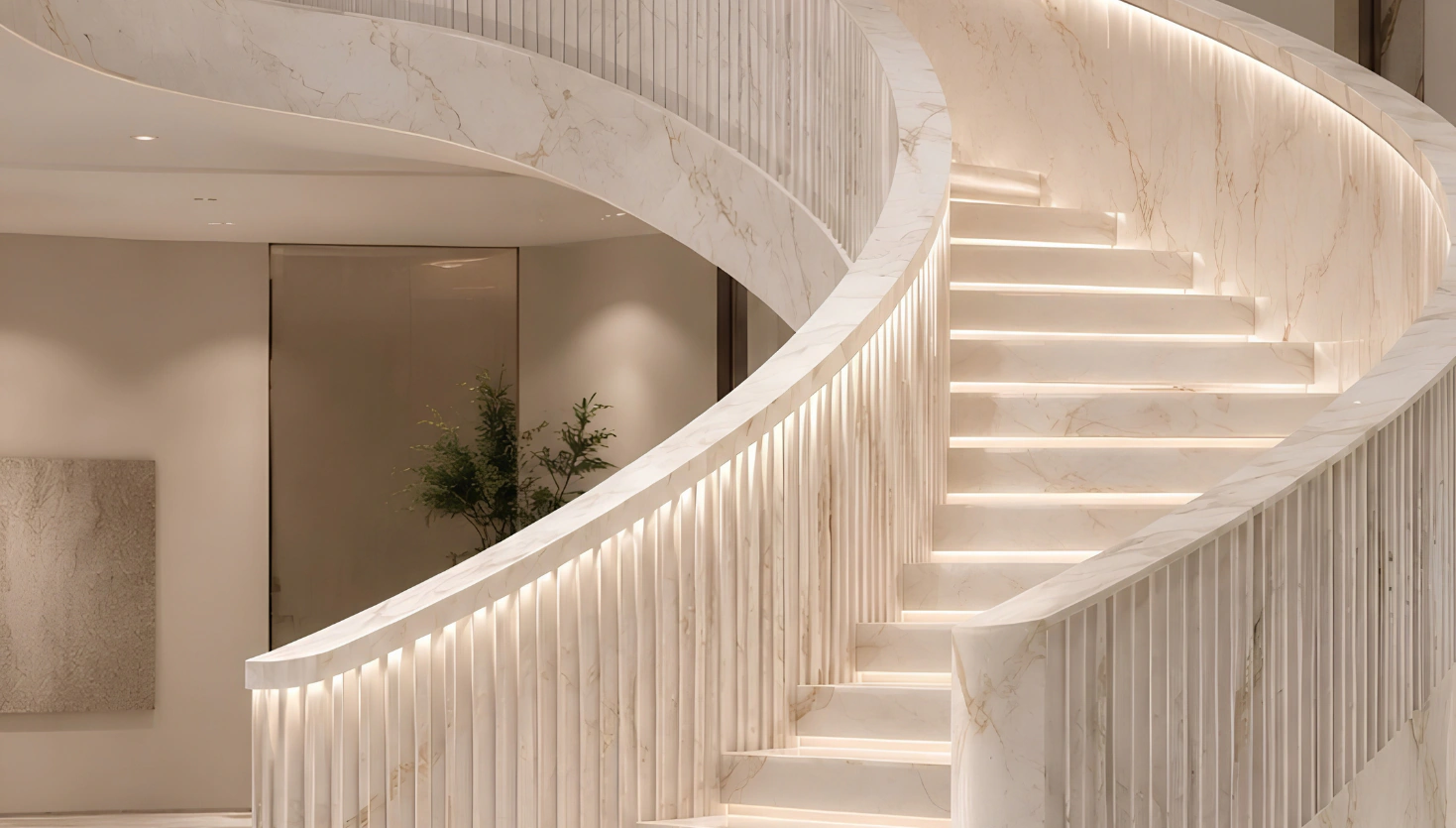
Short answer
To specify a marble staircase, decide the form (straight, curved or helical), the tread and riser thickness, the finish for grip, the nosing profile and the balustrade. Treads are commonly 30 or 40 mm thick, and all the stone for one flight should come from the same seam so it matches.
Form and setting-out
Straight flights are the simplest. Curved and helical stairs need full-size templates taken from the architect's setting-out, so every tread is cut to its exact place in the curve.
Treads, risers and nosings
Treads are commonly 30 or 40 mm thick, with risers thinner. The nosing, the front edge of each tread, can be square, eased or bullnosed. A slightly rounded nosing feels better underfoot and resists chipping.
Finish and grip
Polished marble is beautiful but can be slippery. For main stairs, a honed finish or anti-slip grooves along the nosing are safer; outdoor and pool-side steps should always be honed or textured.
Balustrades and handrails
Carved balusters, moulded handrails and newel posts are best made alongside the flight so profile and colour match. See our grand staircases.
Delivery and installation
A good maker dry-assembles a complex stair in the workshop and numbers each piece in installation order, so it goes together on site without surprises.